
You’ve seen the glowing claims. Face oils promising luminous, hydrated skin with just a few drops. The obvious question follows: can you ditch your moisturizer entirely? Understanding why face oils replace moisturizer in some routines, and why they fall short in others, depends entirely on how each product works at the skin level. This article cuts through the confusion so you can make a confident, informed decision about what your skin actually needs.
Table of Contents
- Key takeaways
- Why face oils replace moisturizer for some skin types
- What the science says about oils and hydration
- Face oils vs moisturizer: pros, cons, and skin types
- How to use face oil in your routine
- Common myths about face oils and moisturizers
- My take on the whole oils-versus-moisturizer conversation
- Upgrade your skin routine with M3naturals
- FAQ
Key takeaways
| Point | Details |
|---|---|
| Oils lock in, not add water | Face oils trap existing moisture but cannot supply water to skin cells on their own. |
| Skin type determines the swap | Very oily or combination skin may tolerate oils alone, but dry and aging skin typically needs both. |
| Layering order matters | Apply moisturizer first, then seal with a face oil for maximum hydration and barrier protection. |
| Formulation beats category | A water-in-oil emulsion outperforms a pure oil or a basic lotion for reducing moisture loss. |
| Myths mislead real choices | Oils don’t automatically clog pores, and rich oils don’t automatically mean better hydration. |
Why face oils replace moisturizer for some skin types
To understand when a face oil can stand in for your moisturizer, you first need to know what each product actually does inside your skin.
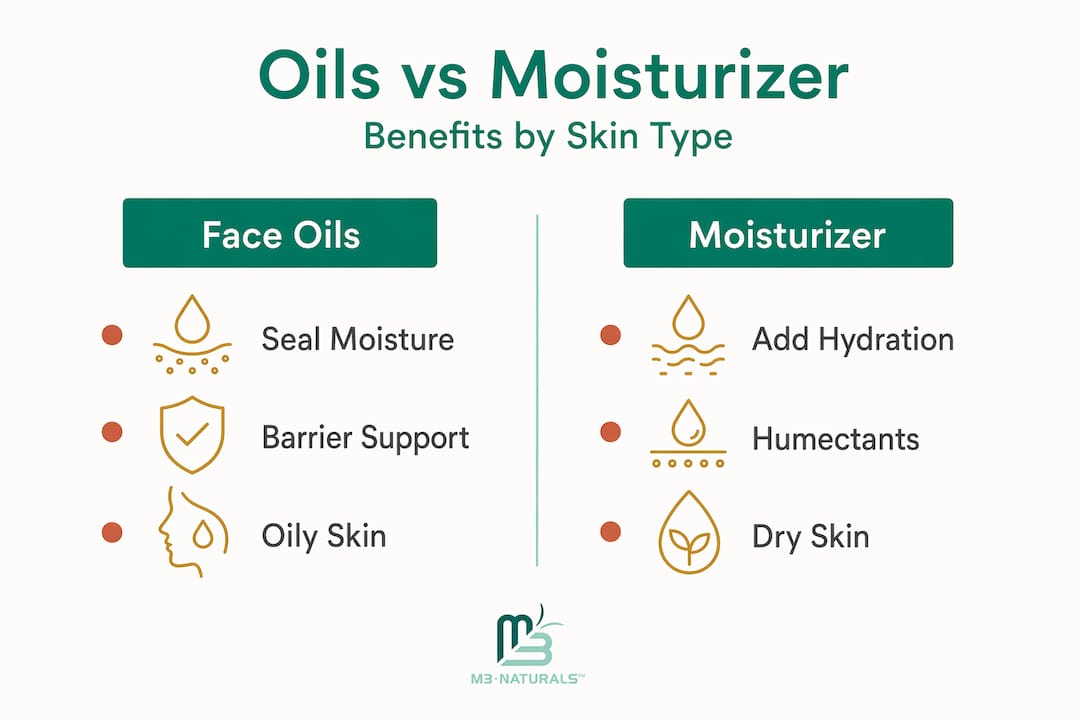
Moisturizers are water-based products built around three types of ingredients. Humectants like hyaluronic acid and glycerin draw water into the skin. Emollients soften and smooth the surface. Occlusives create a film that slows water from evaporating off your face. Most moisturizers combine all three to deliver hydration and keep it there.
Face oils work differently. They are anhydrous, which means they contain zero water. Their job is primarily emollient and occlusive. A good face oil softens the skin’s texture, replenishes lipids in the barrier, and slows transepidermal water loss. What they cannot do is deliver water to your skin cells. That distinction is everything.
Here is where the confusion starts. If your skin is already well-hydrated, applying a face oil absolutely can function as your final moisture-sealing step. It traps that hydration in place effectively. But if your skin is dehydrated, a face oil alone leaves the most important part of the equation out entirely.
Pro Tip: Apply a hydrating serum or toner right before your face oil. Even on days you skip moisturizer, this gives the oil something to seal in rather than sitting on a dry surface.
The synergy between the two products is real. Dermatologists consistently note that oils act as sealants, supporting barrier integrity rather than replacing the hydrating function of a moisturizer. Used together, you get water delivery from the moisturizer and moisture retention from the oil. Used alone, an oil only handles half the job.
What the science says about oils and hydration
Research on skin hydration cuts through a lot of the marketing noise around face oils. The science is more nuanced than either side of the oils-versus-moisturizers debate tends to admit.
A study on water-in-oil emulsions found that combining humectants with oils in an emulsion format reduces transepidermal water loss more effectively than oils used alone. The mechanism involves three simultaneous actions: an oil film that reduces evaporation, a water reservoir that delivers hydration directly, and a polysaccharide film that draws moisture from the environment. Pure oils, by contrast, only cover one of those three bases.
This finding matters because it reframes the question. The best products aren’t necessarily “oil” or “moisturizer.” They’re well-formulated emulsions that combine both intelligently. A water-in-oil emulsion provides better moisture retention than pure oil products, with a lighter feel and stronger barrier protection.
Here is a direct comparison of what each format delivers:
| Product type | Hydration delivered | Barrier protection | Best for skin type |
|---|---|---|---|
| Water-based moisturizer | High | Moderate | Dry, dehydrated, normal |
| Pure face oil | None | High | Oily, combination, as a finishing step |
| Water-in-oil emulsion | High | Very high | Dry, aging, barrier-compromised |
“Anhydrous oils penetrate the stratum corneum and restore essential fatty acids but cannot supply water needed for true skin hydration, limiting their use as standalone moisturizers.” — MDPI Cosmetics Journal
That quote from peer-reviewed research captures the core limitation of a face oil used solo. It is not that oils are ineffective. They do genuinely restore lipids, reduce dryness-related fine lines, and support barrier health. The limitation is that they work best when there is already moisture present to lock in.
Face oils vs moisturizer: pros, cons, and skin types
The advantages of face oils are real and worth understanding clearly. They are not just a trend.
The genuine face oils benefits include:
- Barrier repair: Cold-pressed oils like rosehip deliver essential fatty acids and vitamins that rebuild the skin’s lipid layer, which is particularly useful for dry or aging skin.
- Antioxidant protection: Plant-based oils including sesame, grapeseed, and olive offer photoprotective antioxidant activity beyond basic hydration.
- Non-comedogenic options: Non-comedogenic oils like squalane and jojoba mimic skin’s natural lipids without clogging pores, making them safe even for acne-prone skin.
- Fewer ingredients: For sensitive skin, a single-ingredient oil like sea buckthorn or argan contains less risk of irritation than a multi-ingredient cream.
Moisturizers, on the other hand, bring their own irreplaceable strengths:
- Direct water delivery: They supply actual hydration, not just the retention of it.
- Flexible layering: Lightweight lotions and gels sit well under SPF, makeup, and other products without pilling.
- Humectant action: Ingredients like hyaluronic acid continue pulling moisture into your skin throughout the day.
The moisturizer vs face oil decision often comes down to skin type. If you have naturally oily skin that produces its own sebum in abundance, you may genuinely not need a separate moisturizer. A lightweight, non-comedogenic oil applied after cleansing can support your barrier without adding heaviness. Combination skin follows similar logic in the oily zones.
Dry skin and aging skin tell a different story. Both conditions involve compromised lipid barriers and reduced natural oil production. Using an oil alone in this case is like patching a roof with tape. It helps, but it doesn’t address the underlying gap.
Pro Tip: If you’re deciding whether to use face oil over moisturizer, start with a weekend test. Skip your moisturizer and use only your oil for two days. If your skin feels tight by midday, you need the moisturizer back in the rotation.
How to use face oil in your routine
Whether you use a face oil alongside your moisturizer or in place of it, the order and method matter considerably.
- Cleanse first. Always apply face oil to clean skin. Oil over sunscreen residue or makeup traps the wrong things under your barrier.
- Apply any water-based serums. Hyaluronic acid serums, niacinamide, and similar actives should go on before your oil since they need water contact to penetrate properly.
- Add moisturizer if your skin needs it. For dry, aging, or dehydrated skin, apply your moisturizer at this stage. This is the step face oils cannot replicate.
- Apply your face oil last. Seal everything with 3 to 5 drops of oil, pressing it gently into the skin. Dermatologists recommend this layering order because it maximizes both hydration delivery and moisture retention.
- Apply SPF over everything in the morning. Oils do not replace sun protection, regardless of their antioxidant content.
Seasonal adjustments make a real difference too. In humid summer climates, your skin retains more ambient moisture naturally, which means a lightweight oil alone might genuinely suffice on low-effort days. In dry winter air, your skin loses moisture faster. This is when cutting out the moisturizer in favor of oil alone shows up as tightness, flakiness, and accelerated fine lines.
Choosing the best oils for your face also matters more than most people realize. Heavier oils like marula and avocado work best for very dry skin used at night. Lighter oils like rosehip, jojoba, and squalane work well for daytime or combination skin. An oil that feels perfect in January may feel suffocating in July.
Pro Tip: Always patch test a new face oil on the inside of your wrist for 48 hours before applying it to your face. Even natural, cold-pressed oils can trigger reactions in sensitive skin.
Common myths about face oils and moisturizers
A few persistent misconceptions keep people from using these products correctly.
- Myth: Oils clog everyone’s pores. Not true. Some comedogenic oils in certain moisturizers do trigger breakouts, but non-comedogenic oils like squalane and jojoba are routinely recommended by dermatologists for acne-prone skin. The specific oil and your skin chemistry determine the outcome.
- Myth: Face oils hydrate your skin. Oils make skin feel softer and more supple, which reads as hydration, but they do not supply water. The advantages of face oils are real, but direct hydration is not on that list.
- Myth: All oils leave your skin greasy. Lightweight oils absorb within seconds. If your oil sits on your skin like a film for hours, you’re either using too much or using the wrong oil for your skin type.
- Myth: A product rich in oils must be deeply moisturizing. Richness and moisture content are not the same thing. A thick oil-heavy balm provides tremendous occlusion but zero water. Meanwhile, a light water-based gel delivers high hydration with almost no oil content at all.
Cutting through the marketing hype on this category requires paying attention to ingredient lists rather than claim language on packaging. Words like “nourishing,” “hydrating,” and “restorative” are used interchangeably by brands whether the product is anhydrous or water-based. The ingredient order tells the real story.
My take on the whole oils-versus-moisturizer conversation
I’ll be honest: the “can face oil replace moisturizer” debate frustrates me a little. Not because it’s a bad question, but because it’s the wrong frame.
In my experience, the people who get the best results from face oils are the ones who stop thinking of them as a moisturizer replacement and start thinking of them as a barrier finisher. I’ve seen oily-skin clients genuinely thrive with just a serum and a lightweight oil, their skin balanced and clear. I’ve also seen dry-skin clients swap their moisturizer for an expensive face oil, spend three weeks wondering why their skin looks dull and feels tight, and conclude that oils “don’t work” for them.
The product formulation matters more than the category label. A well-made water-in-oil emulsion often outperforms both a standalone moisturizer and a standalone oil. The irony is that the best skincare formulations already combine the hydrating power of water with the barrier-sealing power of oil. You’ve probably already been using something close to that without realizing it.
My actual advice: use an oil. Use it correctly. Seal in your hydration rather than skip it. Experiment with skipping the moisturizer on oily-skin days and see how your face responds. Your skin is the best data you have.
— SuperNatural
Upgrade your skin routine with M3naturals
If you’re ready to put this into practice, M3naturals offers a curated range of natural oils and skincare products built around the same principles covered here. Clean ingredients, thoughtful formulations, and real results for real skin.

The M3naturals massage oils collection features plant-based, emollient-rich oils sourced from natural botanicals. Whether you’re using oil as a standalone step on low-maintenance days or layering it over your serum for barrier support, these oils deliver the lipid-replenishing properties your skin’s outer layer genuinely needs. Pair them with products from the M3naturals face care line to build a routine that covers hydration and retention together, without guesswork.
FAQ
Can face oil replace moisturizer entirely?
For oily or combination skin in humid climates, a face oil used after a hydrating serum may work as a standalone step. For dry, aging, or dehydrated skin, a moisturizer is still needed because oils cannot supply the water your skin requires.
Should I use face oil before or after moisturizer?
Apply moisturizer first, then seal with a face oil as the final step. Dermatologists recommend this order because oils lock in the hydration the moisturizer delivers rather than blocking it from absorbing.
Do face oils work for oily skin?
Yes. Non-comedogenic oils like jojoba and squalane can actually help balance oil production. The key is choosing lightweight, non-pore-clogging formulas and applying only a few drops.
What makes water-in-oil emulsions better than pure oils?
Water-in-oil emulsions combine a water reservoir, humectants, and emollient oils in one formula, reducing transepidermal water loss more effectively than oils alone. Pure oils only provide occlusion without delivering water.
Are face oils safe for acne-prone skin?
Many are. Squalane, rosehip, and jojoba are considered non-comedogenic and are frequently recommended for skin prone to breakouts. The comedogenicity of any oil depends on the specific formulation and your individual skin chemistry.