
You’ve probably heard that oils are bad for skin, or that all carrier oils behave the same way. Neither is true. Understanding how carrier oils work on skin, what cosmetic chemists call the “lipid vehicle” effect, completely changes how you approach your natural skincare routine. These plant-derived fixed oils do far more than simply coat the surface. They interact with your skin’s barrier at a biochemical level, influence how deeply active ingredients penetrate, and determine how much moisture your skin actually retains.
Table of Contents
- Key Takeaways
- How carrier oils work on skin at a biochemical level
- Comparing popular carrier oils by skin type
- How carrier oils deliver actives deeper into skin
- Practical guidance on choosing and using carrier oils
- My honest take on carrier oils and skincare choices
- Experience the difference that quality carrier oils make
- FAQ
Key Takeaways
| Point | Details |
|---|---|
| Fatty acids drive results | The ratio of oleic to linoleic acid in an oil determines how fast it absorbs and which skin types benefit most. |
| Not all oils work the same | Linoleic-rich oils suit oily and acne-prone skin; oleic-rich oils deliver deep nourishment for dry skin. |
| Carrier oils enhance actives | Oils don’t just moisturize. They carry essential oils and other actives into the skin more effectively. |
| Formulation context matters | The same oil in neat form versus an emulsion produces different hydration and retention outcomes. |
| Storage protects potency | Linoleic-rich oils oxidize quickly and require cool, dark storage and antioxidant support to stay effective. |
How carrier oils work on skin at a biochemical level
Carrier oils are plant-derived fixed oils that form the lipid phase in skincare products. Unlike essential oils, they don’t evaporate, don’t have an overwhelming scent, and aren’t used in tiny amounts. They’re the base. They contain fatty acids, vitamins (particularly Vitamin E), phytosterols, and carotenoids, all of which interact directly with your skin’s outer layer, the stratum corneum.
The real story is in the fatty acid profile. Your skin’s own lipid barrier is made up of a specific ratio of ceramides, fatty acids, and cholesterol. When you apply a carrier oil, its fatty acid composition either complements that barrier or works against it.
Here’s how the main fatty acid types play out:
- Linoleic acid (Omega-6): This polyunsaturated fatty acid absorbs faster and suits oily skin better than most. It reinforces the skin barrier, reduces water loss, and is lighter in texture. Rosehip and evening primrose oils are high in linoleic acid.
- Oleic acid (Omega-9): Found abundantly in argan and olive oil, oleic acid penetrates more deeply and nourishes dry, mature skin. It absorbs more slowly and creates a richer feel on the skin.
- Saturated fats: Coconut and palm kernel oil are loaded with lauric acid, a saturated fat. These oils are more occlusive, sit on top of skin longer, and can clog pores in acne-prone individuals.
The balance of oleic and linoleic acids is the central variable in how well any carrier oil performs for your specific skin type. Oils that are predominantly oleic feel richer and take longer to sink in. Oils that lean linoleic feel lighter and absorb more readily.
Pro Tip: If your skin feels greasy after applying an oil, the issue is almost always the wrong fatty acid profile for your skin type, not the fact that you used an oil at all. Switch to a higher linoleic acid option like rosehip or hemp seed oil.
You can also learn more about when face oils replace moisturizers entirely, which depends heavily on these same fatty acid principles.
Comparing popular carrier oils by skin type
Not all oils are created equal. Below is a comparison of six widely used carrier oils based on their fatty acid profile, comedogenic rating (pore-clogging potential on a scale of 0 to 5), absorption speed, and skin-type fit.
| Oil | Dominant Fatty Acid | Comedogenic Rating | Absorption Speed | Best For |
|---|---|---|---|---|
| Jojoba | Wax esters (mimics sebum) | 2 | Fast | All skin types, oily skin |
| Rosehip | Linoleic acid | 1 | Fast | Acne-prone, aging skin |
| Argan | Oleic acid | 0 | Medium | Dry, mature, sensitive skin |
| Sweet almond | Oleic and linoleic | 2 | Medium | Normal to dry skin |
| Marula | Oleic acid | 3–4 | Slow | Very dry, mature skin |
| Coconut | Lauric acid (saturated) | 4 | Slow | Very dry skin, not face |
Stability matters just as much as fatty acid profile. Linoleic-rich oils oxidize faster and go rancid more quickly than saturated or oleic-dominant oils. This is why rosehip oil should be refrigerated and used within six months of opening, while coconut oil has a shelf life closer to two years at room temperature.
A few practical notes on blending and stability:
- Vitamin E (tocopherol) acts as a natural antioxidant when added to linoleic-rich oils, extending their shelf life noticeably.
- Blending a faster-absorbing oil like jojoba with a richer oil like marula gives you a more balanced texture and performance.
- Fatty acid profile also correlates with acne-prone skin compatibility, which is why linoleic acid is often recommended for breakout-prone skin types.
How carrier oils deliver actives deeper into skin
This is the part most people miss when thinking about the benefits of carrier oils. They are not passive vehicles. The way an oil interacts with the stratum corneum physically opens a pathway for other active compounds, whether those are essential oils, antioxidants, or targeted botanical extracts.
Here is how the process works:
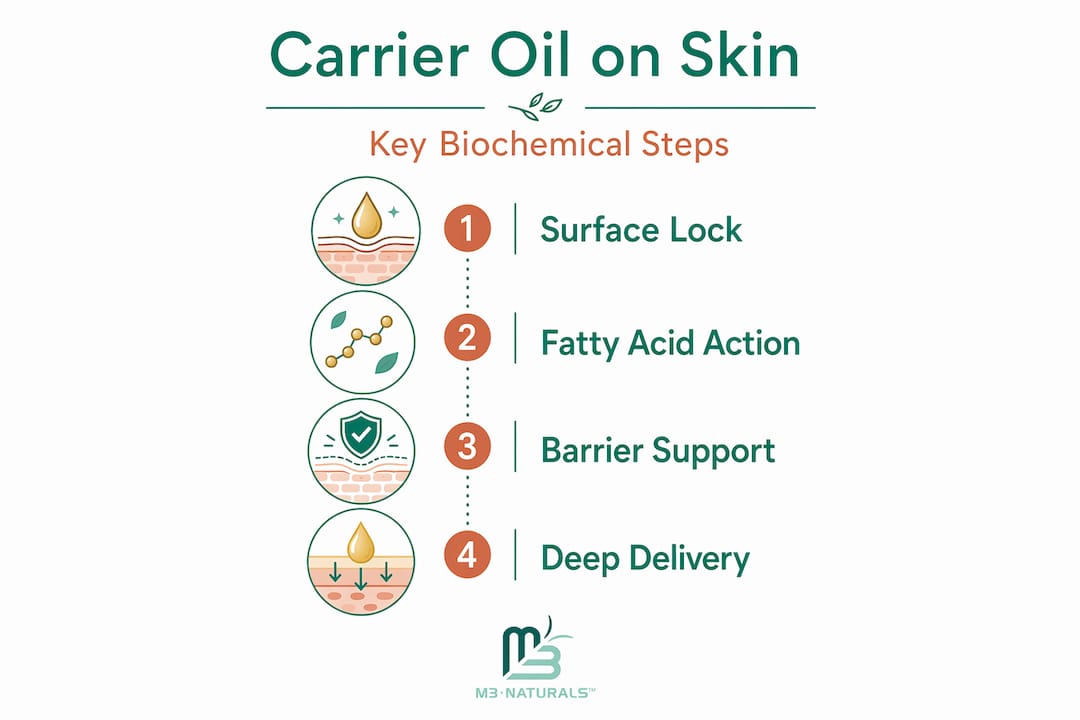
- Skin surface contact: The carrier oil spreads across the skin surface and begins integrating with the outermost lipid layer.
- Barrier permeation: Fatty acids in the oil disrupt the tightly packed lipid structure of the stratum corneum just enough to allow actives to pass through more readily.
- Active compound delivery: Essential oils or other dissolved actives ride through these slightly loosened channels and reach the viable epidermis.
- Retention phase: The oil’s occlusive film slows transepidermal water loss (TEWL), which keeps the delivered actives in contact with skin longer.
Research on oleic acid vesicle systems found that formulations containing oleic acid doubled skin retention and permeation of encapsulated actives compared to control formulations. That’s a significant functional advantage. Oleic acid doesn’t just nourish. It physically reorganizes the lipid bilayer structure temporarily, making it a more effective delivery enhancer than many alternatives.
Occlusivity is also a critical factor here. Carrier oils reduce TEWL by forming a semi-permeable film on the skin surface. Clinical comparisons have shown that oils like extra virgin olive oil improve barrier function comparably to petrolatum, though with lower occlusivity, making them more cosmetically acceptable for daily use.

Formulation structure also matters significantly. The same oil in neat form versus an emulsion produces different skin retention and TEWL outcomes. A water-in-oil emulsion with 30% olive or avocado oil showed measurably increased occlusivity compared to the oil applied alone. So how you use the oil is not a minor detail.
Pro Tip: When using essential oils therapeutically, always dilute them in a carrier oil first. Beyond safety, this actually improves how much of the essential oil reaches your skin’s deeper layers, not less.
Practical guidance on choosing and using carrier oils
Understanding carrier oil skin absorption is useful only if you translate it into a real routine. Here’s a framework for making smart choices without overcomplicating your approach.
Match the oil to your skin type and concern:
- Oily or acne-prone skin: rosehip, hemp seed, or jojoba (low comedogenic, linoleic-dominant)
- Dry or mature skin: argan, sweet almond, or marula (oleic-dominant, deeply nourishing)
- Sensitive skin: jojoba or oat oil (gentle fatty acid profiles, low irritation risk)
- Combination skin: blend a linoleic-rich oil with a small amount of an oleic-rich oil
Recommended ways to use carrier oils effectively:
- As a moisturizer replacement on damp skin after showering (the dampness boosts absorption)
- As a massage base, which also offers lymphatic and circulatory benefits when paired with intentional technique
- As a dilution base for essential oils, typically at a 2 to 3 percent essential oil concentration
Applying carrier oils directly to clean skin is a well-established practice in aromatherapy and natural skincare. The key is applying to slightly damp skin and using only a few drops. More oil does not mean better results. A thin, even layer absorbs faster and performs better than a thick application.
Storage and shelf life tips:
- Store linoleic-rich oils in the refrigerator and use them within six months
- Use dark glass bottles rather than clear plastic to limit oxidative damage from light
- Keep all carrier oils away from direct heat sources
- Add a drop or two of Vitamin E oil to any blend to extend its stability
Pro Tip: Always patch test a new carrier oil on your inner forearm for 24 hours before applying it to your face. Even natural oils can trigger contact reactions, particularly in highly sensitized skin.
My honest take on carrier oils and skincare choices
I’ve worked with natural skincare ingredients long enough to know that the carrier oil conversation is far more nuanced than most content suggests. The advice you’ll find most often, usually something like “rosehip is best” or “coconut oil fixes everything,” treats these oils as interchangeable when the science tells a completely different story.
What I’ve found is that most people struggle not from using the wrong oil entirely, but from using the wrong oil for their particular skin at a particular time of year. Dry winter skin that responds beautifully to argan oil may feel congested and heavy using that same oil in humid summer months. The skin’s needs shift, and your oil selection should shift with it.
I’ve also noticed that people underestimate how much formulation context matters. Dropping an oil on top of a cream is not the same as using a well-formulated oil serum, or a carrier oil massage blend designed to penetrate and retain actives. The same ingredient behaves differently depending on what surrounds it and how it’s delivered. This is the kind of nuance that separates genuinely effective natural skincare from wishful thinking.
My advice: start with one oil that fits your skin type, use it consistently for four to six weeks, and pay attention to how your skin actually responds. Don’t let trending ingredients override what your skin is telling you.
— SuperNatural
Experience the difference that quality carrier oils make
If reading this has you thinking differently about the oils you use or want to use, that’s exactly the point. Understanding the science behind carrier oils is the first step. Using high-quality, well-formulated products is what translates that understanding into real results for your skin.
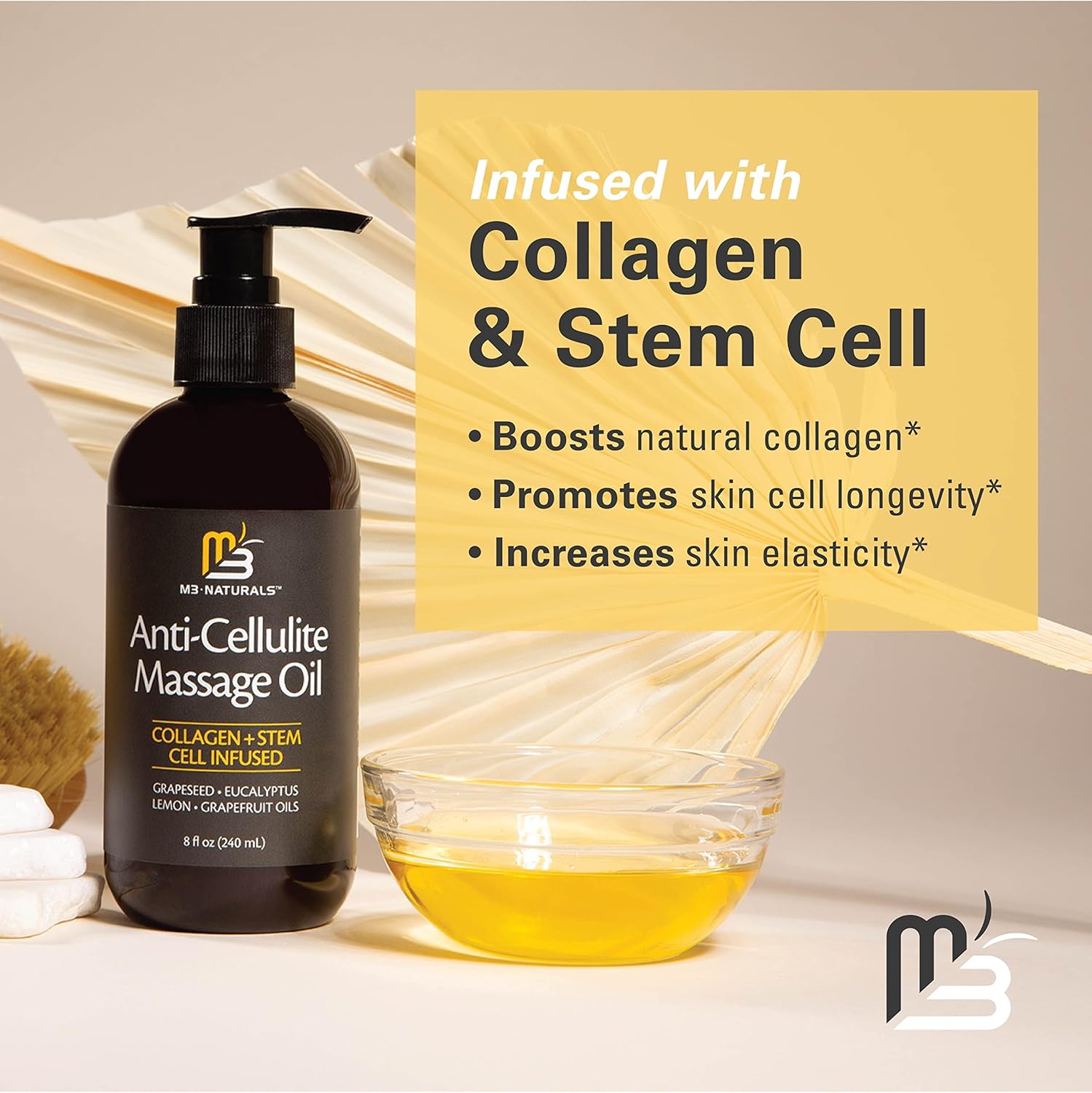
M3naturals formulates its massage oil collection with exactly these principles in mind. Each blend is built around carrier oils selected for their fatty acid profiles, absorption characteristics, and skin compatibility, giving you the benefits of carrier oils in a format that is ready to use immediately. Whether you’re focused on deep hydration, targeted muscle relief, or daily skin wellness, M3naturals products bring spa-quality carrier oil science into your home routine. Explore the full range at M3naturals and find the right blend for your skin’s specific needs.
FAQ
What makes carrier oils different from essential oils?
Carrier oils are fixed, non-volatile plant oils that do not evaporate, while essential oils are concentrated, aromatic compounds that evaporate quickly. Carrier oils form the lipid base in skincare and are safe to apply directly to skin without dilution.
How does carrier oil skin absorption actually work?
Carrier oils integrate with the stratum corneum’s lipid structure, and their fatty acids temporarily loosen the skin barrier enough to allow actives to pass through. The oil’s occlusive film then reduces TEWL and keeps those actives in contact with skin longer.
Which carrier oils are best for dry skin?
Oleic acid-rich oils like argan, sweet almond, and marula are the best carrier oils for dry skin because they penetrate deeply and provide lasting nourishment. Apply them to slightly damp skin to maximize absorption and lock in moisture.
Can carrier oils clog pores?
Some can. Coconut oil and marula oil have high comedogenic ratings and can clog pores in acne-prone skin. Jojoba and rosehip oil have low comedogenic ratings and are far safer choices for oily or breakout-prone skin types.
How should carrier oils be stored to stay effective?
Linoleic-rich oils like rosehip should be refrigerated and used within six months, while more saturated oils like coconut oil can be stored at room temperature for up to two years. Dark glass containers and a drop of Vitamin E oil extend the shelf life of any carrier oil blend.