

Most people assume cellulite is simply a matter of carrying extra fat. That assumption is wrong, and it’s why so many treatments fail. What is cellulite explained scientifically comes down to a structural skin condition, formally called gynoid lipodystrophy, where subcutaneous fat pushes upward through a weakened mesh of fibrous connective tissue. The result is the characteristic dimpling you see on thighs, hips, and buttocks. Cellulite affects 80 to 98% of post-pubertal women, which makes it one of the most common skin conditions on the planet. Understanding the biology beneath the surface changes everything about how you approach it.
Table of Contents
- Key takeaways
- What is cellulite explained scientifically: the biology beneath your skin
- Why some people get more cellulite than others
- What science says about treating cellulite
- Lifestyle strategies that actually make a difference
- My honest take on cellulite complexity
- Support your skin with M3naturals
- FAQ
Key takeaways
| Point | Details |
|---|---|
| Structural, not just fat | Cellulite results from fat herniating through connective tissue bands, not excess fat alone. |
| Women are disproportionately affected | Vertical septae in women’s skin allow fat to bulge upward; men’s criss-cross bands hold it down. |
| Multiple factors drive it | Genetics, circulation, aging, and lifestyle all contribute. No single cause explains every case. |
| Fat loss alone rarely fixes it | Losing weight reduces fat volume but leaves connective tissue architecture largely unchanged. |
| Treatments vary widely | Procedures targeting fibrous bands offer the most durable results; topical products work temporarily. |
What is cellulite explained scientifically: the biology beneath your skin
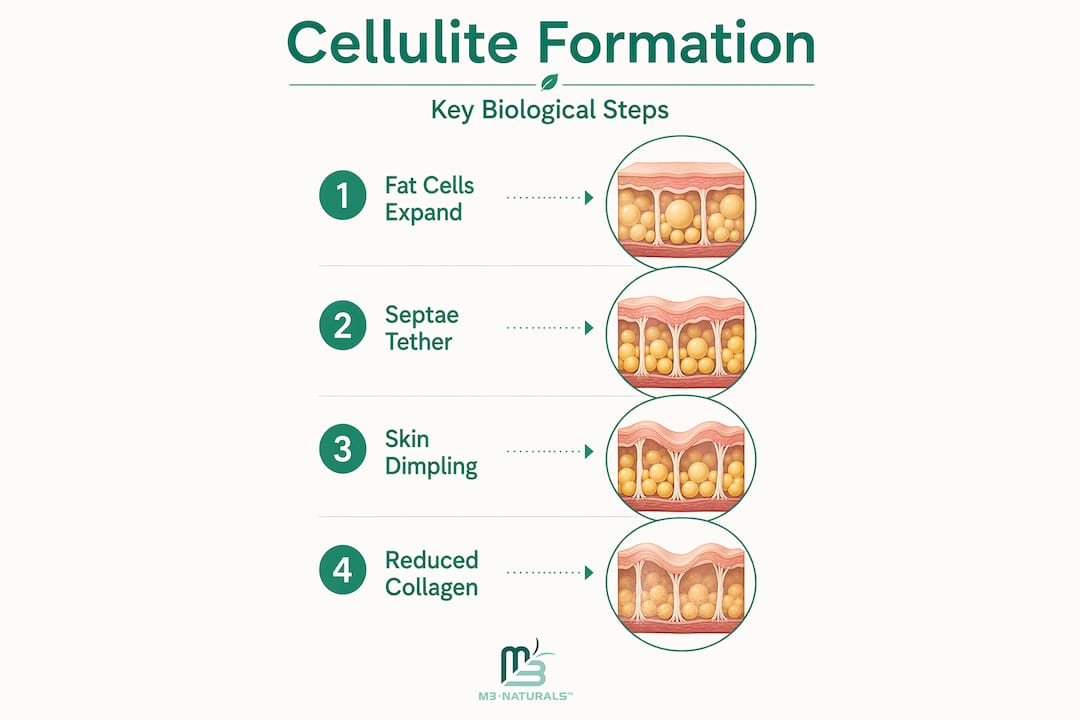
To understand how cellulite forms, you need a mental picture of what lies beneath the skin’s surface. Your skin has three main layers: the epidermis (outer), the dermis (middle), and a deeper layer of subcutaneous fat. Running through that fat layer are fibrous connective tissue strands called septae. Think of them as vertical columns anchoring your skin to the deeper muscle fascia below.
In healthy, younger skin, those septae are firm and evenly spaced. Fat cells sit in compartments between them, contained and flush with the skin surface. But when fat cells enlarge or the septae weaken and lose elasticity, the fat pushes upward through gaps in the connective mesh. The septae simultaneously pull the skin downward. You get fat bulging up, tissue pulling down, and that produces the puckered, dimpled surface texture people recognize as cellulite.
The gender difference in this anatomy is striking. Men have criss-cross oriented septae that hold fat cells firmly in place regardless of how much fat is present. Women have vertically oriented septae, which offer far less resistance. Fat cells can herniate through those vertical gaps far more easily, which is the primary biological reason cellulite is dramatically more common in women than in men.
Aging makes the picture worse. As estrogen declines and skin loses collagen density over time, the dermis thins and the septae become less elastic. The structural support weakens from two directions at once. Even women who maintain a stable body weight can develop more pronounced cellulite purely because their connective tissue architecture has changed with age.
Pro Tip: If you want to visualize how this works, imagine pressing your fingers into a loosely woven net bag holding oranges. The oranges (fat cells) push through the gaps in the net (septae), and the net pulls the surface down at attachment points. That’s the mechanical reality of cellulite.
Here’s a quick breakdown of the structural factors at play:
- Subcutaneous fat: Fat cells in the hypodermis enlarge and push upward against the dermis
- Fibrous septae: Connective tissue bands that anchor skin to fascia; weaken and lose elasticity with age
- Dermal thinning: Thinner skin makes the underlying fat compartments more visible at the surface
- Skin elasticity loss: Reduced collagen and elastin production worsens skin’s ability to smooth over fat protrusions
| Structural Component | Role in Cellulite Formation |
|---|---|
| Subcutaneous fat cells | Enlarge and herniate through septae gaps |
| Fibrous septae (women) | Vertical orientation allows fat to bulge upward |
| Fibrous septae (men) | Criss-cross orientation resists fat herniation |
| Dermal collagen | Thins with age, reducing surface smoothness |
| Skin elasticity | Declines over time, worsening dimple visibility |
Why some people get more cellulite than others
The formation of cellulite involves metabolism, connective tissue structure, hormonal factors, genetics, microcirculation, and low-grade inflammation. No single factor is solely responsible. This multifactorial nature is why two people with identical body fat percentages can have dramatically different cellulite patterns.
Genetics play a significant early role. Your inherited connective tissue structure, fat distribution patterns, and skin thickness all influence how visible cellulite becomes. Some people are born with denser, more resilient septae. Others inherit a septae arrangement that predisposes them to dimpling even at low body weights.

Circulation and lymphatic drainage matter more than most people realize. Blood flow in cellulite-affected areas can be up to 35% lower compared to unaffected skin. Poor microcirculation reduces nutrient delivery to the dermis and slows waste removal. The result is a localized environment where connective tissue degrades faster and fat cells accumulate metabolic byproducts that may worsen tissue quality.
Hormonal influences are real but often overstated. Estrogen affects fat distribution and connective tissue composition. However, there is no reliable clinical evidence directly linking estrogen levels to cellulite risk. The relationship is indirect and complex. This is why simply changing hormonal status does not reliably reduce cellulite.
Sedentary behavior is a clear lifestyle contributor. Physical inactivity reduces local circulation, allows fat cells to remain enlarged, and weakens the muscle tone that provides structural support beneath the skin. Tight clothing that restricts blood flow can worsen lymphatic drainage over time, compounding the effect.
| Risk Factor | Contribution Level | Mechanism |
|---|---|---|
| Genetic predisposition | High | Determines septae architecture and skin properties |
| Female sex | High | Vertical septae allow fat herniation |
| Aging | High | Collagen loss, thinning dermis, weaker septae |
| Poor circulation | Moderate | Reduces tissue oxygenation, slows waste clearance |
| Sedentary lifestyle | Moderate | Decreases muscle tone and local blood flow |
| Diet and hydration | Moderate | Influences fat cell size and tissue fluid balance |
| Hormonal factors | Low to moderate | Indirect effects on fat and connective tissue |
What science says about treating cellulite
This is where honest information gets rare. Most people want a simple solution. Science says the problem is structural, and you cannot fix structure with a cream.
Topical treatments have not demonstrated long-term efficacy. Creams and gels that claim to break down fat or tighten skin may temporarily improve hydration and surface texture, making cellulite look slightly less visible. But they cannot penetrate deeply enough to reach the septae. The fibrous bands pulling skin downward remain completely unaffected. Any visual improvement fades within days.
For more durable results, procedural treatments targeting the connective tissue itself are the most evidence-backed options:
- Cellfina: A minimally invasive procedure that uses a needle-sized device to mechanically release the fibrous bands causing dimpling. Clinical data shows improvements lasting two or more years.
- Cellulaze: An FDA-approved laser treatment that uses laser energy delivered under the skin to cut tethering septae and stimulate collagen production in the dermis. Results can persist for a year or longer.
- Acoustic wave therapy: A non-invasive option that uses pressure waves to stimulate circulation and break up fibrous tissue. Results are modest and require multiple sessions, but there is no downtime.
The critical insight from clinical research is this: releasing fibrous septae through targeted procedures smooths skin appearance far more effectively than reducing fat volume alone. Fat reduction through diet and exercise is beneficial for overall health and can reduce fat cell size, but it leaves the connective tissue architecture largely intact.
Pro Tip: When evaluating any cellulite treatment, ask one question before anything else: does this treatment address the fibrous septae or only the fat? If the answer is only the fat, manage your expectations accordingly.
| Treatment Type | Mechanism | Invasiveness | Expected Duration |
|---|---|---|---|
| Cellfina | Mechanical band release | Minimally invasive | 2+ years |
| Cellulaze | Laser energy, band disruption | Minimally invasive | 1+ year |
| Acoustic wave therapy | Pressure wave stimulation | Non-invasive | Months, with upkeep |
| Topical creams | Surface hydration only | Non-invasive | Days to weeks |
| Diet and exercise | Fat volume reduction | Non-invasive | Ongoing, partial improvement |
Lifestyle strategies that actually make a difference
Clinical procedures offer the most structural change, but your daily habits determine how visible cellulite is on a day-to-day basis. These strategies won’t remove connective tissue bands, but they genuinely reduce the appearance of cellulite and support skin health over time.
Exercise improves circulation and muscle tone, both of which mitigate cellulite visibility. Strength training in particular builds the muscle beneath cellulite-prone areas, providing a firmer base that makes the skin surface look smoother. Cardio exercise supports blood flow throughout the dermis and helps the lymphatic system clear excess fluid that can worsen puffiness around cellulite.
Diet quality and hydration matter for skin texture. Keeping fat cells from enlarging further, reducing systemic inflammation, and supporting collagen production through adequate protein intake all contribute. Processed foods high in sodium cause fluid retention that temporarily worsens cellulite’s visible severity.
Massage and dry brushing improve local circulation and stimulate lymphatic drainage. These techniques won’t remodel connective tissue, but they temporarily plump the skin with increased blood flow, which reduces the contrast between dimples and surrounding skin. Using a lymphatic drainage roller consistently can be a useful adjunct to both exercise and clinical care.
Here is what the evidence supports as daily practices:
Do:
- Strength train at least twice a week targeting the legs, glutes, and hips
- Stay consistently hydrated to maintain skin turgor and support lymphatic flow
- Use massage, dry brushing, or exfoliating tools to stimulate surface circulation
- Eat anti-inflammatory foods and prioritize lean protein for collagen support
- Wear loose, non-compressive clothing during extended periods of sitting
Avoid:
- Long periods of sitting without movement breaks
- High-sodium processed foods that worsen fluid retention
- Yo-yo dieting, which repeatedly expands and contracts fat cells and may stress septae
- Expecting topical products alone to produce structural change
My honest take on cellulite complexity
I’ve spent a lot of time reviewing how cellulite is discussed in both clinical and wellness contexts, and the gap between the two worlds is frustrating. In clinical settings, dermatologists understand this as a structural issue with connective tissue. In wellness marketing, it gets reduced to a fat problem with a product-shaped solution.
What I’ve found is that durable improvement depends on identifying which factors dominate for a specific individual. Someone whose cellulite is driven primarily by poor circulation will respond differently than someone whose issue is largely genetic septae architecture. There is no single protocol that works for everyone, and anyone who tells you otherwise is oversimplifying.
What actually shifts people’s results is combining approaches: a clinical procedure to address the structural issue, consistent exercise to support circulation and muscle tone, and daily habits that keep inflammation and fluid retention low. The at-home options aren’t magic, but they are genuinely useful as part of that larger strategy.
I also want to say plainly that cellulite is physiological, not pathological. It is not a sign of poor health or lack of discipline. Even thin, fit people develop it because their connective tissue architecture predisposes them to it. Pursuing improvement is completely reasonable. Treating it as a personal failing is not.
— SuperNatural
Support your skin with M3naturals

The science on cellulite is clear: the most meaningful change comes from targeting the connective tissue, not just the surface. But that doesn’t mean at-home care is irrelevant. Regular massage, exfoliation, and targeted topicals can visibly improve skin texture, reduce puffiness, and support circulation between clinical treatments or as a standalone practice. M3naturals offers a range of products built specifically for this. Their anti-cellulite body scrub uses professional-grade exfoliants to remove dead skin and stimulate the surface layer, while their massage oils collection is formulated to support skin elasticity during daily massage routines. For those who want mechanical stimulation to support lymphatic flow, the silicone body brush pairs effectively with oils to maximize each session.
FAQ
What exactly is cellulite at the biological level?
Cellulite, formally called gynoid lipodystrophy, occurs when subcutaneous fat herniates through fibrous connective tissue bands called septae, creating a dimpled surface. It is a structural skin condition, not simply excess fat accumulation.
Why do women get cellulite more than men?
Women have vertically oriented connective tissue septae that allow fat cells to bulge upward through gaps, while men’s criss-cross septae hold fat firmly in place. This anatomical difference is the primary reason cellulite is far more common in women.
Can losing weight get rid of cellulite?
Weight loss can reduce the size of fat cells and slightly diminish cellulite’s appearance, but it does not change the underlying fibrous septae structure. Cellulite can occur at any body size and cannot be completely removed through fat loss alone.
Which treatments are most effective for cellulite?
Procedures that directly release or disrupt the fibrous bands, such as Cellfina and Cellulaze, produce the most durable results. Multi-modal treatments that address circulation, fat volume, and connective tissue together yield the best outcomes.
Do topical creams actually reduce cellulite?
Topical creams can temporarily improve skin hydration and surface texture, making cellulite look slightly less visible for a short period. They cannot reach the fibrous septae beneath the skin, so they produce no long-term structural change.