


Beauty sleep is defined as the body’s restorative process during deep sleep, during which skin cells repair, collagen production increases, and skin elasticity is restored. This is not a folk saying. Sleep medicine research confirms that what is beauty sleep science comes down to measurable biological activity: blood flow to the skin rises, cortisol drops, and cellular regeneration accelerates. Over 33% of American adults regularly get fewer than the recommended 7 hours of sleep per night. That gap between what the body needs and what most people get shows up directly on the skin.
What is beauty sleep science, and how does it work biologically?
Sleep is the body’s primary window for skin barrier repair. The most critical phase is deep slow-wave sleep, when cortisol levels fall to their lowest point of the day. That hormonal shift matters because collagen protection during slow-wave sleep cannot be replicated by topical products alone. No serum or cream can substitute for the collagen maintenance that happens only during consistent, quality sleep.
During deep sleep, blood flow to the skin increases, collagen production ramps up, and cellular repair accelerates. That increased circulation delivers oxygen and nutrients while removing toxins and free radicals. Think of it as a nightly detox and rebuild cycle that runs automatically, but only when you give it enough time to complete.
Circadian rhythms control skin cellular behavior, and misalignment with these cycles increases skin water loss and vulnerability to environmental damage. Irregular sleep schedules, shift work, and late-night screen exposure all disrupt this internal clock. The result is a skin barrier that leaks moisture and struggles to defend itself.
Key biological processes that occur during quality sleep:
- Collagen synthesis: Fibroblast activity peaks during slow-wave sleep, building the structural protein that keeps skin firm.
- Cell turnover: Skin cells divide and replace damaged ones at a faster rate overnight than during waking hours.
- Barrier repair: The skin’s outer layer rebuilds its lipid structure, reducing water loss and improving hydration.
- Inflammation reduction: Lower cortisol levels allow the immune system to calm existing skin irritation.
- Detoxification: Blood flow carries away metabolic waste products that accumulate in skin tissue throughout the day.
Pro Tip: Apply your most active skincare ingredients, such as retinoids or peptides, right before bed. Skin absorption and cellular receptivity are both higher during the nighttime repair cycle, making your products work harder.
What happens to your skin when sleep is poor or insufficient?
Chronic sleep deficiency is defined as fewer than 7 hours of sleep per night for at least 3 months. Chronic sleep deficiency disrupts collagen production, weakens the skin barrier, and fuels inflammation that impairs healing. The damage compounds over time, meaning a week of poor sleep looks different on skin than a year of it.
Short-term effects appear faster than most people expect. Just two nights of 3 hours of sleep cause measurable reductions in skin elasticity and more noticeable wrinkles. That is a remarkably short window for visible change, and it explains why skin looks noticeably worse after even one bad night.
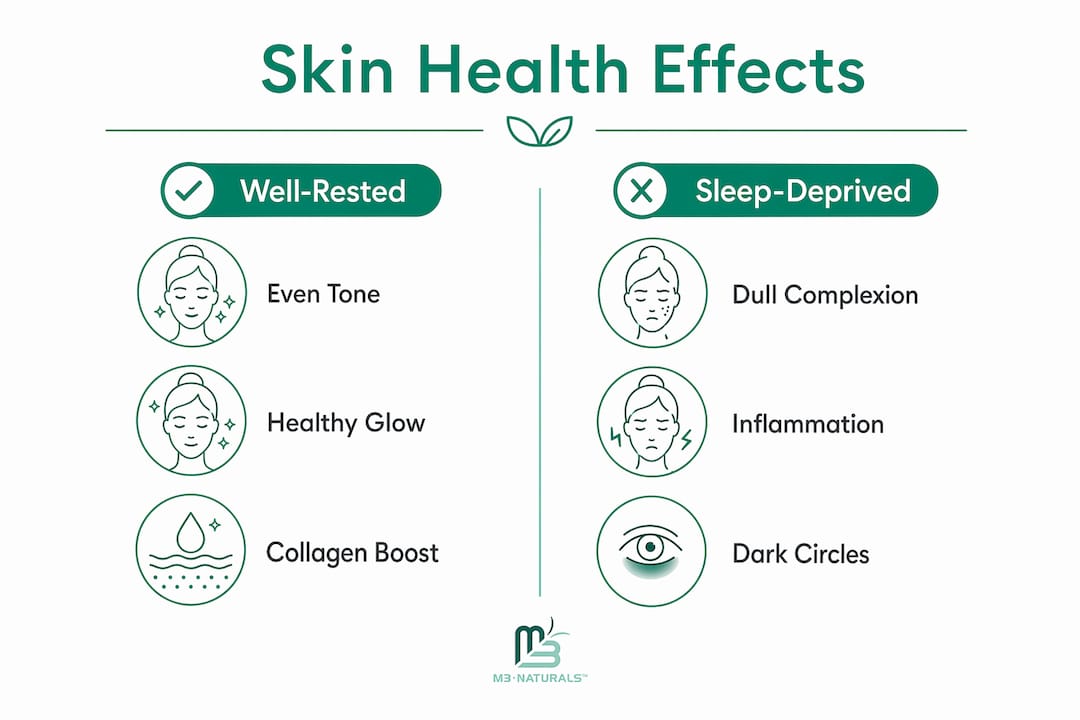
Poor sleep elevates cortisol, which triggers excess oil production, increases inflammation, and worsens conditions like acne and eczema. Elevated cortisol also breaks down existing collagen, accelerating the appearance of fine lines. The skin essentially ages faster under chronic stress from sleep loss.
| Skin condition | Well-rested skin | Sleep-deprived skin |
|---|---|---|
| Complexion | Even tone, healthy glow | Pale, dull, uneven |
| Elasticity | Firm, resilient | Reduced, sagging |
| Under-eye area | Minimal discoloration | Dark circles, puffiness |
| Hydration | Barrier intact, moisture retained | Increased water loss, dryness |
| Inflammation | Low, calm | Elevated, prone to breakouts |
Dark circles from sleep deprivation may also signal fluid shifts, and persistent dark circles that do not improve with better sleep can indicate anemia or other underlying health issues. If better sleep does not resolve them within a few weeks, a medical consultation is worth pursuing.
Pro Tip: Sleeping on your back reduces fluid pooling around the eyes and minimizes sleep line formation on the face. A slightly elevated pillow position also helps drain excess fluid overnight.
Does sleep improve appearance and social perception?
The science behind beauty sleep extends beyond skin biology into social psychology. Sleep deprivation causes visible signs including paler skin, darker eye circles, red or swollen eyes, drooping eyelids, and downturned mouth corners. Observers consistently rate sleep-deprived faces as less attractive and less healthy, even without knowing the person’s sleep history.
People perceived as more attractive and healthier when well-rested experience better social outcomes in job interviews and dating contexts. This is not superficial. The facial cues that signal sleep deprivation are the same cues humans use to assess health, vitality, and trustworthiness in others. Looking rested communicates competence and energy before a single word is spoken.
Sleep deprivation changes facial cues in ways that statistically reduce the likelihood of social interaction. Well-rested people are approached more often, perceived as more approachable, and rated as more likable in controlled studies. The effect runs in both directions: sleep-deprived people also perceive others more negatively, which compounds the social cost.
The practical implications are significant:
- Job interviews: Rested candidates are rated as more alert, confident, and capable by interviewers.
- First impressions: Facial symmetry and skin tone, both improved by sleep, are processed within milliseconds of meeting someone.
- Relationships: Sleep deprivation reduces empathy and emotional regulation, affecting how people connect with others.
- Self-perception: People who sleep well consistently report higher confidence in their appearance, independent of objective changes.
A holistic skincare approach that includes sleep as a foundational element produces results that topical products alone cannot match. The skin you present to the world reflects the quality of rest you give your body each night.
How to optimize sleep quality for better skin health
The Sleep Foundation recommends 7–9 hours of sleep per night for adults. Hitting that range consistently is more important than any single night of extended sleep. The skin repair cycle needs repeated, uninterrupted deep sleep phases to complete its work fully.
Sleep hygiene practices that directly support skin health:
- Keep a consistent schedule. Go to bed and wake up at the same time every day, including weekends. Consistency anchors your circadian rhythm, which governs the skin repair cycle.
- Cool your bedroom. A room temperature between 65°F and 68°F promotes deeper sleep stages where the most significant skin repair occurs.
- Eliminate light exposure. Darkness signals melatonin release. Even small amounts of light from screens or streetlights can delay melatonin and shorten deep sleep.
- Limit screens 60 minutes before bed. Blue light from phones and tablets suppresses melatonin production and delays sleep onset.
- Build a nighttime skincare routine. Cleansing, moisturizing, and applying targeted treatments before bed prepares skin to absorb ingredients during the repair window.
- Manage stress actively. Chronic stress keeps cortisol elevated, which directly counteracts the collagen-protecting effects of sleep. Practices like breathwork, journaling, or light stretching lower cortisol before bed.
- Watch your diet in the evening. High-sugar meals and alcohol before bed disrupt sleep architecture and reduce time spent in deep slow-wave sleep.
Exercise also supports skin health by improving circulation and reducing cortisol, both of which complement the nighttime repair process. Timing matters: morning or afternoon exercise improves sleep quality, while intense workouts within two hours of bedtime can delay sleep onset.
Pro Tip: A brief self-massage with a calming oil before bed, focusing on the neck, shoulders, and face, lowers cortisol and signals the nervous system to shift into rest mode. This directly supports the hormonal conditions your skin needs for overnight repair.
Key takeaways
Quality sleep is the single most accessible and scientifically supported tool for skin repair, collagen production, and long-term skin health.
| Point | Details |
|---|---|
| Sleep drives skin repair | Deep slow-wave sleep triggers collagen synthesis, cell turnover, and barrier restoration every night. |
| Sleep loss shows fast | Just two nights of severely restricted sleep produces measurable reductions in skin elasticity and visible wrinkles. |
| Cortisol is the key villain | Poor sleep raises cortisol, which breaks down collagen, increases oil production, and worsens acne and eczema. |
| Social perception is real | Well-rested faces are consistently rated as more attractive, healthy, and approachable in controlled studies. |
| 7–9 hours is the target | The Sleep Foundation recommends 7–9 hours nightly for adults to support full skin repair cycles. |
Sleep and skin: what the research actually changed for me
The phrase “beauty sleep” always sounded like an excuse to stay in bed. Then I started looking at the dermatological research, and the picture changed completely. The collagen finding is the one that stopped me. No topical product can replicate what slow-wave sleep does for collagen maintenance. That means every night of poor sleep is a night your skin ages slightly faster, and no morning routine fully compensates for it.
What I see consistently is that people invest heavily in skincare products while treating sleep as optional. They spend real money on serums and treatments, then stay up until 1 a.m. on their phones. The biology does not support that trade-off. The skin barrier repairs itself at night. Circadian rhythm disruption increases water loss and reduces the skin’s ability to defend itself. These are not soft claims. They are measurable outcomes documented in peer-reviewed research.
The uncomfortable truth is that sleep is the cheapest and most effective skin treatment available, and most people are not using it. Pairing consistent sleep with a well-maintained skin pH and a targeted nighttime routine produces compounding results over weeks and months. The skin reflects what you do every night, not just what you apply in the morning. Start treating sleep as a non-negotiable part of your skin health routine, not a luxury you fit in when life allows.
— SuperNatural
M3naturals products that support your nighttime skin routine
A consistent nighttime routine amplifies everything your skin does during sleep. The right products prepare your skin to absorb, repair, and restore more effectively through the night.

M3naturals body scrubs remove the dead skin cell buildup that blocks absorption, so your moisturizers and treatments reach deeper layers where repair actually happens. Used two to three times per week before bed, they leave skin primed for the overnight cycle. M3naturals massage oils, formulated with botanical ingredients like lavender and ylang ylang, support muscle relaxation and skin nourishment simultaneously. A short evening massage lowers cortisol, signals the nervous system toward rest, and delivers nutrients directly to skin tissue before the repair window opens.
FAQ
What is beauty sleep science in simple terms?
Beauty sleep science is the study of how deep sleep triggers skin cell repair, collagen production, and barrier restoration. These processes are driven by hormonal shifts and increased blood flow that occur specifically during slow-wave sleep.
How many hours of sleep does skin actually need?
The Sleep Foundation recommends 7–9 hours of sleep per night for adults. Fewer than 7 hours consistently disrupts collagen synthesis and skin barrier function.
Can poor sleep cause acne?
Poor sleep elevates cortisol, which increases oil production and inflammation, directly worsening acne and eczema. Improving sleep quality is one of the most effective ways to reduce hormonally driven breakouts.
Do dark circles always mean you need more sleep?
Dark circles often result from sleep deprivation and fluid shifts, but persistent dark circles that do not improve with better sleep may indicate anemia or other health conditions. A dermatologist or physician can rule out underlying causes.
Does a nighttime skincare routine actually make a difference?
Applying skincare products before bed takes advantage of the skin’s heightened repair activity during sleep. Ingredients like retinoids and peptides are absorbed more effectively during the nighttime cycle, making a consistent routine significantly more productive than morning-only application.